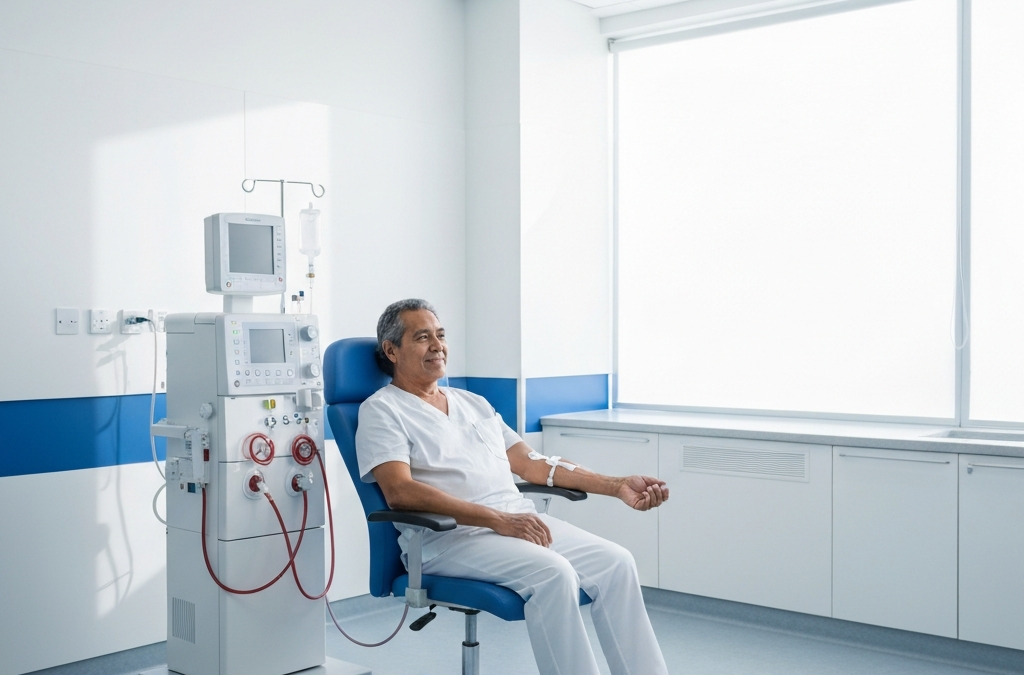
The Technical Verdict: The selection of a Haemodialysis modality is governed by clinical necessity, patient stability, and logistical capability. The three core methodologies are conventional in-center Haemodialysis for supervised treatment, home Haemodialysis for greater patient autonomy, and nocturnal haemodialysis for extended, gentle therapy.
The integrity of the treatment is fundamentally dependent on a robust, low-failure-rate vascular access, with the arteriovenous fistula representing the gold standard from an engineering and clinical perspective.
What is Haemodialysis and How Does It Work?
Haemodialysis is a renal replacement therapy engineered to perform the function of failed kidneys, specifically the removal of metabolic waste products and excess fluid from the blood. The process operates on fundamental principles of mass transfer across a semipermeable membrane within a component known as a dialyzer, or artificial kidney. Your blood is circulated on one side of this membrane, while a sterile fluid, the dialysate, flows in a counter-current direction on the other.
This configuration maximises the concentration gradients necessary for efficient waste removal. Two primary physical mechanisms drive the process: diffusion and ultrafiltration. Diffusion is the movement of solutes, like urea and creatinine, from an area of high concentration (the blood) to an area of low concentration (the dialysate). Ultrafiltration describes the removal of excess water by creating a hydrostatic pressure gradient across the membrane.
Core Scientific Principles
The effectiveness of haemodialysis is built upon precise engineering and biological metrics designed to mimic renal function.
The following core scientific principles govern the efficacy and safety of the treatment:
- Kt/V Measurement: This calculated metric ensures dialysis adequacy, where K represents urea clearance, t is treatment time, and V is total body water; a target of 1.2 or higher is standard for effective waste removal.
- The Dialyzer: Often called an “artificial kidney,” this device contains thousands of hollow polymeric fibers, such as polysulfone, which act as a semi-permeable membrane.
- Selective Permeability: The microscopic pores within the dialyzer fibers are engineered to allow the passage of small waste molecules while retaining essential blood cells and large proteins.
- Dialysate Composition: This controlled solution of purified water, electrolytes, and glucose is customized to correct specific chemical imbalances and facilitate the exchange of toxins via diffusion.
- Extracorporeal Circuitry: A sophisticated closed-loop system that utilizes a blood pump to maintain consistent pressure and flow from the vascular access through the dialyzer and back to the patient.
By integrating these advanced biophysical processes, the dialysis machine serves as a high-performance system essential for maintaining physiological stability in patients with kidney failure.
The 3 Main Types of Haemodialysis
The selection of a Haemodialysis modality is a critical clinical decision that balances a patient’s medical requirements with their lifestyle and the available healthcare infrastructure.
At Advanced Renal Care, we focus on aligning these technical capabilities with individual diagnosed needs. Below are the three main types of Haemodialysis:
- In-Center Haemodialysis (Conventional): Performed in a specialized clinic or hospital setting, typically three times per week for approximately four hours per session. This modality is fully managed by trained medical staff who monitor the procedure and handle complications, providing a high level of safety and access to industrial-grade infrastructure.
- Home Haemodialysis (HHD): Managed by the patient and a care partner in their own residence after extensive training. This option allows for greater autonomy and scheduling flexibility, often involving more frequent sessions (five to six times per week) which can lead to improved blood pressure control and better clinical outcomes.
- Nocturnal (Overnight) Haemodialysis: Conducted while the patient sleeps for six to eight hours, three to seven nights a week, either at home or in a specialized unit. The extended duration allows for a slower, gentler filtration process that effectively removes waste and fluid with less cardiovascular strain and fewer dietary restrictions.
Ultimately, the ideal modality is one that optimizes clinical stability while integrating seamlessly into the patient’s daily life and long-term health goals.
Specialized Haemodialysis Modalities
Beyond the standard treatment frameworks, specialised haemodialysis modalities have been engineered to address specific, critical clinical scenarios. These advanced forms of renal replacement therapy are typically employed in intensive care unit (ICU) settings for patients who are hemodynamically unstable or have multi-organ failure.
Modalities such as Continuous Renal Replacement Therapy (CRRT), Hemodiafiltration (HDF), and Sustained Low-Efficiency Dialysis (SLED) offer a higher degree of control over fluid and solute removal, tailored to the acute needs of critically ill patients. These are not standard outpatient treatments but represent the pinnacle of renal support technology for complex cases.
Continuous Renal Replacement Therapy (CRRT)
Continuous Renal Replacement Therapy is a slow, continuous form of blood purification used almost exclusively in the ICU. It is designed for hemodynamically unstable patients with acute kidney injury who cannot tolerate the rapid fluid shifts of conventional intermittent haemodialysis. CRRT operates 24 hours a day, gently removing toxins and fluid, which helps to stabilise the patient’s system without causing shock.
The therapy can be delivered in several ways, including continuous venovenous hemofiltration (CVVH), which relies on convection, or continuous venovenous hemodialysis (CVVHD), which uses diffusion. A combination, CVVHDF, uses both mechanisms. Because blood is outside the body for extended periods, the extracorporeal circuit is prone to clotting, often necessitating some form of anticoagulation. CRRT provides precise control over fluid balance and electrolyte levels, making it a vital tool in managing critically ill patients.
Hemodiafiltration (HDF) and SLED
Hemodiafiltration (HDF) and Sustained Low-Efficiency Dialysis (SLED) offer specialized approaches to renal replacement therapy by prioritizing toxin removal and hemodynamic stability. HDF utilizes a high-flux dialyzer and replacement fluid to combine diffusion with convection, effectively clearing larger middle-molecular-weight toxins that standard methods miss. In contrast, SLED acts as a hybrid therapy, operating at lower flow rates over extended 6-to-12-hour periods to accommodate critically ill patients. This gentler pace provides the stability of continuous therapy while maintaining the resource efficiency of conventional equipment. Consequently, these methods allow clinicians to tailor treatments to the specific molecular needs and physical tolerances of unstable patients.
Types of Vascular Access for Haemodialysis
Vascular access is the vital “lifeline” of hemodialysis, enabling the high flow rates required for effective blood filtration. Whether using an arteriovenous fistula, graft, or central venous catheter, each method carries distinct risks regarding longevity, infection, and thrombosis. Because the durability of this site directly dictates treatment success and patient survival, its careful selection and maintenance are the most critical components of renal therapy.
Arteriovenous (AV) Fistula
The AV fistula is widely regarded as the “gold standard” for haemodialysis access. It is created surgically by directly connecting an artery to a vein, usually in the forearm. This connection bypasses the capillaries and allows high-pressure arterial blood to flow into the vein, causing the vein to enlarge and its walls to thicken over time. This process, known as maturation, can take several weeks to months.
Once mature, the fistula provides a robust, long-lasting access point made entirely of the patient’s own biological tissue. This autogenous nature is its key engineering advantage; it has the lowest rates of infection and clotting (thrombosis) compared to other access types. An AV fistula, when properly cared for, can remain functional for many years, even decades, making it the superior choice for long-term renal replacement therapy.
Arteriovenous (AV) Graft
An AV graft is the second-best option when a patient’s veins are too small or weak to create a functional fistula. This method involves surgically implanting a synthetic tube, typically made of a biocompatible material like polytetrafluoroethylene (PTFE), to connect an artery and a vein under the skin. The graft serves as an artificial vessel that can be repeatedly cannulated for dialysis. Grafts generally mature faster than fistulas and can often be used within two to four weeks.
However, their performance-to-cost ratio is lower over the long term. As a foreign material, an AV graft has a significantly higher risk of infection and clotting compared to an AV fistula. The lifespan of a graft is also shorter, often requiring periodic interventions to maintain patency or replacement every few years.
Central Venous Catheter (CVC)
A central venous catheter is a flexible plastic tube inserted into a large central vein, such as the internal jugular vein in the neck or chest.
CVCs are typically used for immediate, temporary access when a patient needs to start dialysis urgently and does not have a mature fistula or graft. While they offer the advantage of immediate use, CVCs are associated with the highest rates of morbidity.
- AV Fistula: Lowest risk of infection and clotting; longest lifespan; requires weeks to months to mature.
- AV Graft: Usable within weeks; higher risk of infection and clotting than a fistula; shorter lifespan.
- Central Venous Catheter: For immediate/temporary use; highest risk of bloodstream infections and clotting; can damage central veins.
The external portion of the catheter provides a direct entry point for bacteria, leading to a high risk of catheter-related bloodstream infections.
Long-term use can also cause complications like thrombosis within the catheter or fibrin sheath formation around it, leading to poor blood flow and inadequate dialysis. Furthermore, they can cause central venous stenosis, a narrowing of the major veins that can compromise future access options on that side of the body.
Comparing Haemodialysis vs. Peritoneal Dialysis
When considering renal replacement therapy, the two principal methodologies are haemodialysis and peritoneal dialysis. While both are designed to remove waste and excess fluid, their operational mechanics and engineering principles are fundamentally different. Haemodialysis is an extracorporeal therapy, meaning the blood is processed outside the body using an artificial dialyzer.
In contrast, peritoneal dialysis is an intracorporeal therapy that utilises the patient’s own peritoneal membrane, the lining of the abdominal cavity, as a natural filter. A specialised dialysis solution is introduced into the abdominal cavity through a surgically placed catheter. Waste products and excess fluid move from the blood vessels in the peritoneum into the dialysis solution via diffusion and osmosis.
A Technical Comparison
The choice between these two distinct systems depends on a variety of clinical and lifestyle factors. Haemodialysis requires functional vascular access and typically involves fixed treatment schedules, whether at a center or at home. Peritoneal dialysis offers more continuous therapy and can often be performed at home without a machine (Continuous Ambulatory Peritoneal Dialysis) or overnight with a machine (Automated Peritoneal Dialysis), allowing for greater lifestyle flexibility.
From a material science perspective, haemodialysis relies on synthetic polymer membranes in the dialyzer, while peritoneal dialysis leverages a biological membrane. However, peritoneal dialysis carries a significant risk of peritonitis, an infection of the peritoneal membrane, which can be a serious complication. Dialysis adequacy is measured differently; Kt/V for haemodialysis focuses on urea clearance from the blood, while for peritoneal dialysis, it measures waste products in the drained dialysis fluid and urine.
Choosing the Right Modality: Factors to Consider
Selecting a dialysis modality is a precise clinical decision tailored to a patient’s unique physiological needs rather than a universal standard. A nephrologist evaluates several technical variables to engineer an effective treatment plan, specifically focusing on:
- Cardiovascular Stability: This determines how well a patient can tolerate the significant fluid shifts and pressure changes during sessions.
- Vascular Health: The condition of the veins and arteries dictates whether a preferred, long-lasting AV fistula can be successfully created.
- Clinical Goals: Underlying medical conditions help prioritize either toxin clearance efficiency or hemodynamic gentleness.
Clinical and Lifestyle Integration
Selecting the ideal dialysis modality requires balancing clinical necessity with the realities of a patient’s daily life and support system. Home-based therapies, such as nocturnal or home hemodialysis (HHD), demand significant technical competence and motivation but offer greater flexibility for work, school, or travel. While clinical adequacy; measured by toxin and fluid clearance; is the priority, a sustainable plan must also minimize treatment burden to maximize quality of life. Ultimately, the chosen therapy should be a dynamic decision, evolving alongside the patient’s changing health status and personal circumstances to ensure long-term success.
Precision Solutions with Advanced Renal Care
We understand that the success of renal replacement therapy is contingent on the precision of the equipment and the integrity of the methodology. Our technical solutions are engineered for guaranteed performance and reliability in demanding South African healthcare environments.
We specialise in providing SABS-certified equipment and support systems that meet the highest industrial-grade standards for safety and operational efficiency. A professional consultation with our specialists is essential to ensure your chosen modality is technically compliant and clinically effective. Request an appointment via WhatsApp using the button below.
FAQs
What are the three most common types of haemodialysis?
The three most common types are conventional in-center haemodialysis, home haemodialysis (HHD), and nocturnal haemodialysis. In-center treatment is supervised and occurs at a clinic three times a week. Home haemodialysis offers more flexibility and is managed by the patient. Nocturnal haemodialysis involves longer, gentler sessions overnight, either at home or in a center.
Is home haemodialysis as effective as in-center treatment?
Yes, research indicates that home haemodialysis is as safe and effective as in-center treatment. It can offer additional benefits, such as improved blood pressure control and better quality of life, often because it allows for more frequent or longer dialysis sessions. However, it requires significant patient training, commitment, and a suitable home environment.
What is the “Gold Standard” for dialysis vascular access?
The arteriovenous (AV) fistula is considered the “gold standard” for vascular access. Because it is created using the patient’s own blood vessels, it has the lowest risk of infection and clotting and offers the best long-term durability compared to AV grafts or central venous catheters.
What is the difference between haemodialysis and hemodiafiltration?
Haemodialysis primarily uses the principle of diffusion to remove small waste molecules from the blood. Hemodiafiltration is a more advanced therapy that combines diffusion with a high rate of convection. This process removes not only small molecules but also larger “middle molecules,” providing a more comprehensive clearance of uremic toxins.